

Visual Evoked Potential
What Is a Visual Evoked Potential (VEP) Test?
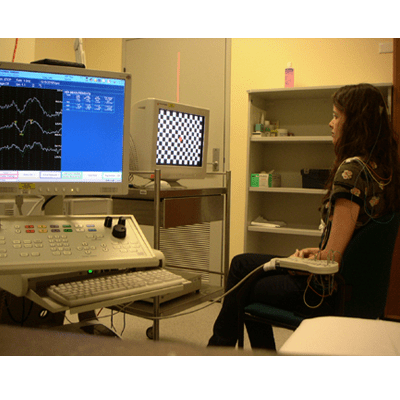
A Visual Evoked Potential is an evoked potential brought about by a visual improvement, for example, a substituting checkerboard design on a PC screen. Reactions are recorded from terminals that are set on the rear of your head and are seen as a perusing on an Electroencephalogram (EEG).
VEP uses:-
- Loss of vision (this can be difficult or non-agonizinge
- Obscured vision;
- Adjustments in shading vision; or
- Shortcoming of the eyes, arms or legs.
Contant Our Neurosurgeons in Purnia, Bihar
Book An Appointment
Frequently Asked Questions
Answers to Your Neurology Queries
Visual Evoked Potential (VEP) is a diagnostic test that measures the brain's response to visual stimulation. It helps doctors evaluate the visual pathway and identify certain problems affecting the optic nerves or brain.
No. A VEP specifically measures the brain's response to visual stimulation, while a regular EEG records the brain's general electrical activity. Both use electrodes, but they are performed for different diagnostic purposes.
Normal VEP results generally show appropriate electrical responses to visual stimulation. A neurologist interprets the results based on factors such as response timing, waveform, and the patient's symptoms.
A VEP test usually takes about 30 to 60 minutes, depending on the testing method and the number of visual responses being assessed.
The cost of a VEP test can vary depending on the diagnostic center, location, and type of testing required. Contact the clinic for the current test charges.